


The remains of the San Juan Gate have been uncovered
In July 2018, restoration work began on Calle de San Juan in Segovia, during which excavations brought to light the remains of the ancient San Juan Gate in the city walls.
Originally, the city walls had five gates. Today, only three remain: those of San Andrés, San Cebrián and Santiago. The other two, San Juan and San Martín, were demolished in the 19th century following a popular movement supported by the municipal architect, Joaquín Odriozola, a proponent of the ‘ensanche’ theory, which advocated the regularisation of street alignments within the walled enclosure, even if this entailed the demolition of gates and historical features.
The following is a concise account of the remains discovered during the restoration works on one of Segovia’s main thoroughfares.
Medieval City Wall Tower – San Juan Gate
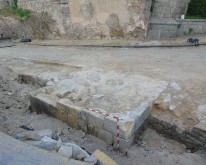
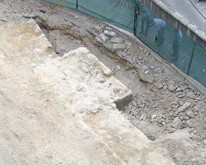
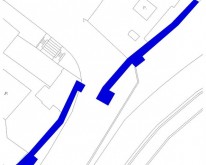
At the upper end of the street, on the right-hand side, the medieval wall tower mentioned in various documents and engravings was located. It is a rectangular structure, built of irregular masonry clad with well-squared limestone ashlars, except for the inner side, which retains the original masonry. It has a ground plan measuring 3.8 m on the E-W axis and 3.2 m on the N-S axis.
The maximum visible height of this tower is 0.92 m, but its preserved height is likely to be greater since, as is the case at other points along the wall, the structure will be resting on the natural limestone bedrock. Given the significant difference in elevation between the upper part of Calle de San Juan and Paseo de Santo Domingo de Guzmán, the original medieval tower likely retains much of its height, all of which is covered by the current masonry cladding added during Joaquín Odriozola’s works in 1888. Thus, the part now uncovered is the upper section of the wall, not its foundations.
The archway on San Juan Street
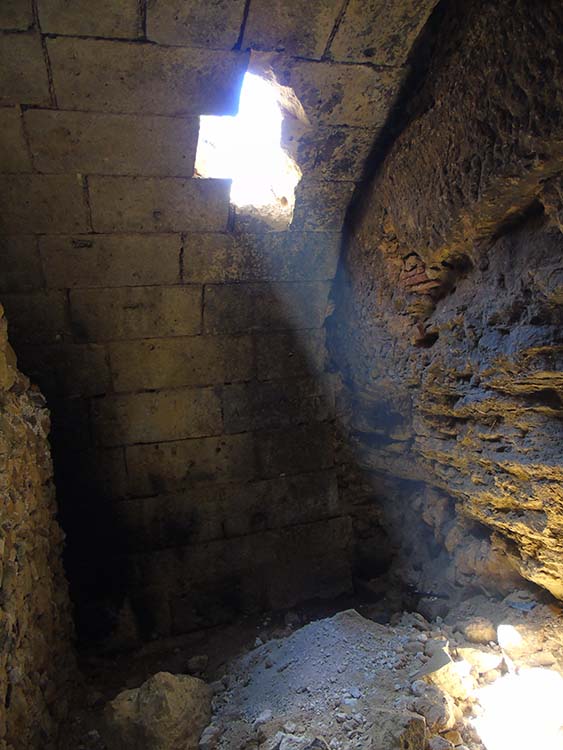
It is a partially blocked vault located underground at the level of the tower in the city wall next to the Casa de las Cadenas. The vault is constructed from limestone blocks and measures 2.3 m in depth, 5.4 m in width and 3.4 m at its highest point. At the top, this vault is covered by a rather loose masonry structure.
It is a fairly stable structure, showing no signs of collapse, built with limestone blocks of varying sizes, joined with mortar. The base on which the vault rests has not been located. A 1x1x1 m test pit was dug in the north-west corner without reaching bedrock. The excavated sediment was very uniform, consisting of sandy soil with no associated archaeological materials, and rested directly against the vault’s walls. The north side of the structure rests directly against the rock face, whilst the south side has been intentionally blocked off, possibly during the last street renovation works carried out in the 1960s.
The sole purpose of this vault was to address a lack of bedrock on which to lay the road. At this point, the bedrock disappears, so it was decided to construct the vault as a bridge to reach the higher section of the road.
Author: Clara Martín García. Archaeologist.