
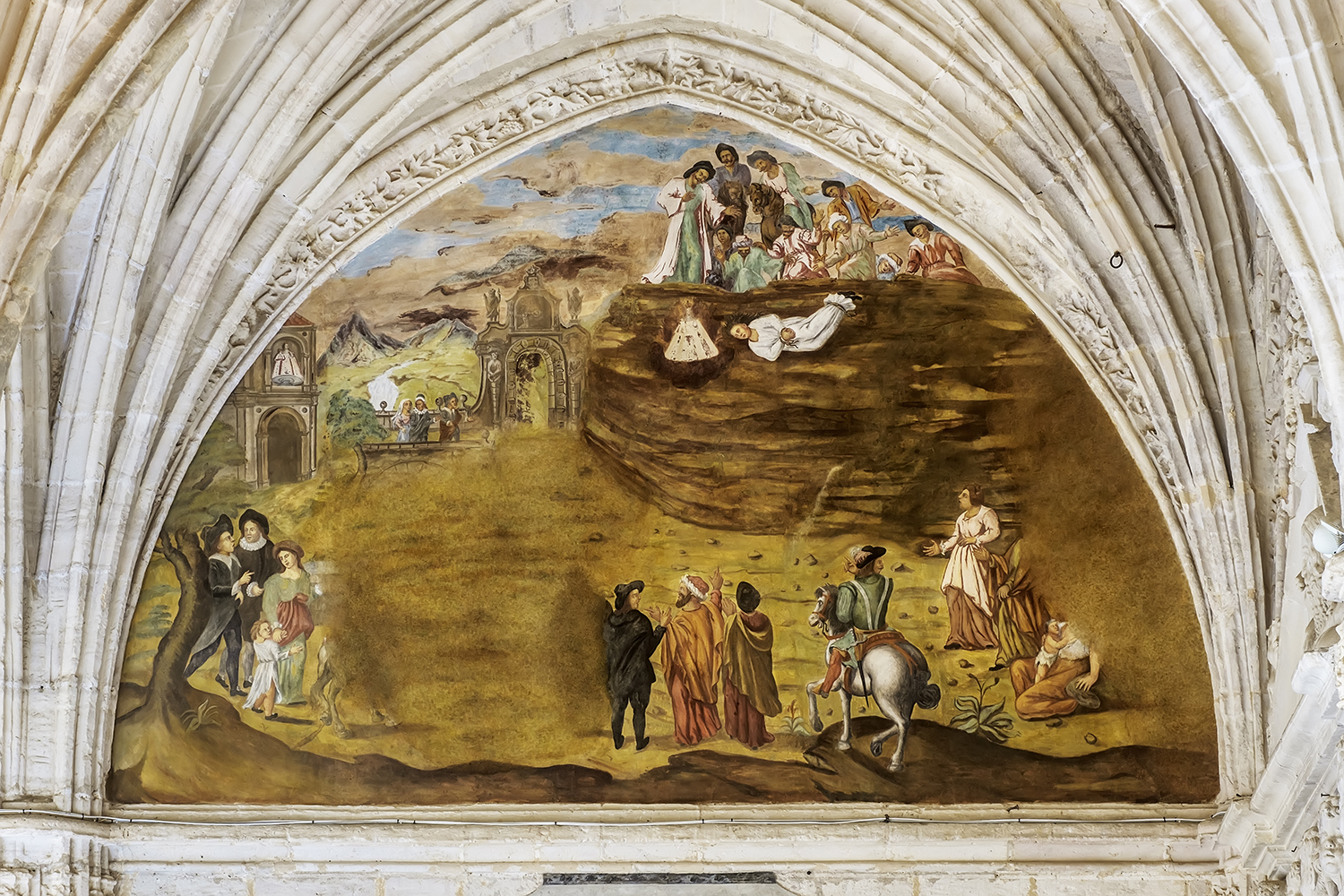
THE MIRACLE OF THE JEWISH WOMAN BAPTISED AS MARIA DEL SALTO
Fray Rodrigo de Cerrato was a Dominican friar known today as a chronicler and hagiographer for his work, in which he compiled various biographies of saints, recorded a number of miraculous events and commented on various moments in the liturgical cycle. Among the Marian themes addressed by the Dominican was the miracle of the Jewish woman who saved her life in Segovia thanks to the intervention of the Virgin.
As he himself recounts around 1237, a Christian woman accused another Jewish woman of having committed adultery with her husband. The judges, considering the gravity of the crime and the necessary atonement for the Christian faith, sentenced the accused to be thrown to her death from a cliff on the outskirts of the city. Upon reaching the place of execution, the Jewish woman was bound and stripped of her clothes, except for a shirt. The woman kept proclaiming her innocence and, seeing herself as lost, decided to entrust herself to the Virgin Mary. She was then thrown into the void, but miraculously suffered no harm in the fall, as the numerous Christians, Jews and Muslims who had gathered to witness the execution were able to see.
Having thus proven her innocence and convinced that she had been spared thanks to the Virgin’s intervention, the Jewish woman requested baptism. From that moment on, she was known as Marisaltus or María del Salto. María because this was the Christian name she had chosen in praise of the Virgin, and del Salto in memory of the miracle that had prevented her death.
Friar Rodrigo concludes his account by stating that he was in Segovia, heard the story from many witnesses and saw the woman in question with his own eyes.
Another point of interest regarding María del Salto is the existence of her tomb in the Old Cathedral, a building that no longer stands and which was situated in the Middle Ages opposite the city’s Alcázar. Today, this tomb can be found in the New Cathedral of Segovia. For further information, click here
The existence of this tomb is a fact, but as the date and circumstances of its construction are unknown, one must be very cautious when considering this as proof of the actual existence of the Jewish woman saved through the intercession of the Virgin.
Since the Baroque period, the figure of María del Salto has come to be associated with Marian devotion to the Virgin of Fuencisla, patron saint of the city of Segovia. Similarly, the site of the fall was identified with the Grajeras rocks, at the foot of which the sanctuary of Fuencisla was built. However, a careful review of medieval documentation suggests that the emergence of this beloved devotion for the people of Segovia did not occur, at least, until the end of the 15th century.
Below is cantiga 107, ‘Quen crever na Virgen Santa’, which recounts the entire legend mentioned above.
Fuente del artículo: extracto del libro El Patrimonio Judío de la ciudad de Segovia. Bonifacio Bartolomé