Imagen de cabecera

Royal Mint of Segovia

Construction of a prototype hydraulic wheel

The Segovia Mint, also known as the Royal Mint, was one of the most important coin-minting factories in Spain. It was built between 1583 and 1588 by order of King Philip II on the banks of the River Eresma, and operated as a coin factory until 1869.

The King commissioned the project to his architect Juan de Herrera, who designed an industrial building specifically conceived to carry out the entire minting process, from the control of the arrival of the raw metal to the final product, the coin.

The new factory was a model of internal organisation with a mass production process, a precursor to the new forms of industrial production that would emerge more than two hundred years later during the Industrial Revolution.

One of its most notable features was the high level of mechanisation in the coinage process, which harnessed the hydraulic energy of the River Eresma by means of water wheels that powered various machines.

The Royal Mint consists of two distinct groups of buildings:

  • Those located in the upper part, where the smelter, warehouses and administration offices, among others, were located.
  • Those located next to the Eresma River, where the hydraulically powered machines were located.

The system of rolling mills and cylindrical coin presses was cutting-edge technology at the time. This new technology arrived in Spain in 1585 thanks to the good relations between King Philip II and his cousin, Archduke Ferdinand of Tyrol.

Transporting these machines, built at the Hall Mint in Tyrol, to Spain was a diplomatic and technical challenge. They were accompanied by eight expert coiners who were responsible for setting them up, as well as other companions and guards.

Currently, nothing remains of the wheels or the machinery used. The challenge of building the water wheels, undoubtedly important elements in the restoration of the complex, gave us the idea of studying, designing and building a first experimental wheel. The idea was presented to the FUNDACIÓN JUANELO TURRIANO.

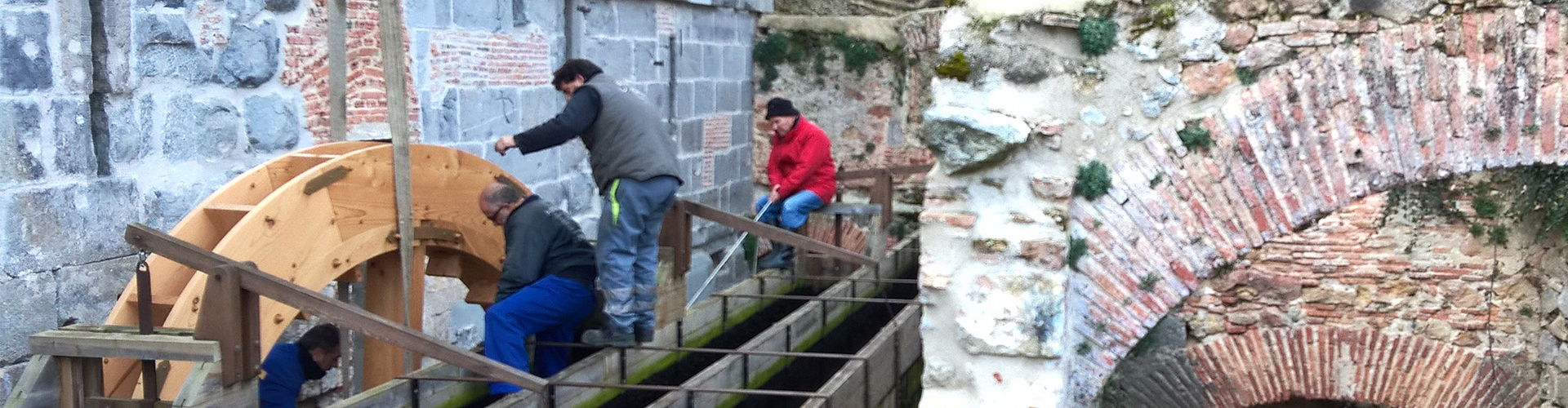
The project was very well received by the Foundation, which decided to commission us to carry out the historical study, the construction design and the physical production of a prototype wooden wheel, covering the costs and then handing it over to those responsible for the Mint.

DESIGN AND CONSTRUCTION OF THE WATER WHEEL

The following sources have been used to obtain information on the characteristics of the wheels and mechanisms:

  • Written documents, mainly reports and memoirs drafted when it was necessary to renovate or repair the facilities in Segovia. There are no plans or other images available to define the wheels at our mint, but we do have the holes in the wall where the wheel axles passed through, which tell us about maximum levels and diameters.
  • Other textual documents referring to the Cuenca Mint, which, as we know, was built in 1661 based on the Segovia model. We do have a magnificent plan of this mint, drawn up in great detail, to a known scale, which clearly shows the system of channels, the water wheels with their saetines, the rolling and minting machines and the blacksmith's tools.

The characteristics and dimensions shown on it coincide with the information on the Segovia Mill, so we can consider this plan to be a good source of information on the Segovia facilities. We decided that for the first prototype wheel it would be best to experiment with one of the small ones from the ironworks. The lathe wheel, the largest of the three, was chosen.
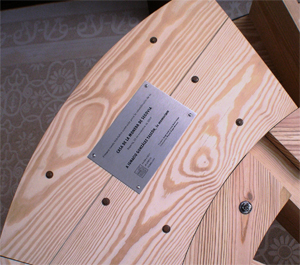
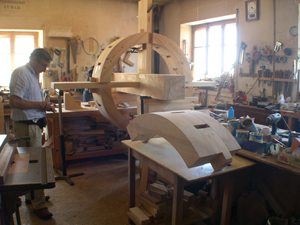
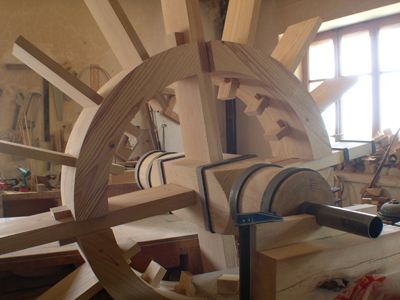
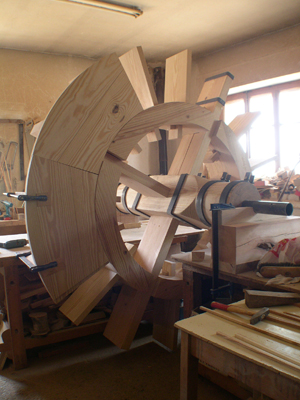
The wheel was constructed using the information available in the documentation. We know that it had 16 spokes, two crossbars attached its structure to the tree, it had axles, it was one Castilian foot wide, and the sides were closed by sideboards.

We have given it a diameter of 2.20 metres (8 Castilian feet).

The information provided by known historical documents has been faithfully followed.

In areas not clarified by the documents, 16th and 17th century models and technology have been used.

It has been designed with the aim of ensuring that it actually works, being capable of moving the machinery correctly.

In accordance with the above criteria, the design has been completed in the light of current technical knowledge, seeking the best possible operation and performance, and requiring the simplest possible maintenance and easy replacement of parts that may deteriorate in the future.

At no point has an attempt been made to build a wheel that visitors would interpret as original, but rather to achieve a wheel that is as close as possible to those built in the 16th century, while making it clear that it is a modern construction.

José María Izaga and Jorge Miguel Soler were responsible for the historical study and design of the wheel.

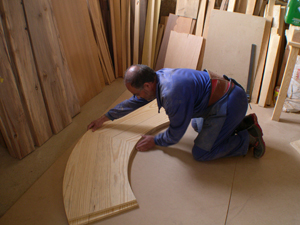
Miguel Ángel Moreno was the craftsman who built the wooden wheel.