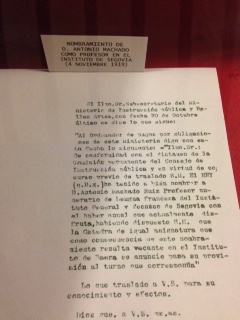
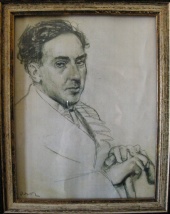
Antonio Machado arrived in Segovia on 25 November 1919 to take up the position of French teacher at the city's General and Technical Institute. He taught at this school until 1932, serving as deputy headmaster for several years.
The press at the time reported on his arrival, with newspapers writing:
"Yesterday, the vigorous and cultured poet Antonio Machado arrived in this town to take up his recently appointed position as Professor of French at the General and Technical Institute. In his beautiful verses, he has sung the praises of Castile, of which he is a fervent lover. We send him our warmest greetings and hope he enjoys his stay in this old Castilian city, where the brilliant poet will surely find inspiration." El Adelantado de Segovia. Thursday, 27 November 1919.
"Antonio Machado, the poet of Castile, returns to Castile, (...) Today he returns to Castile, coming to Segovia to teach French at our school, and here, as in that other city, he will pour into his cadenced and austere verses the deep emotions that this sister city and this fraternal countryside will awaken in the Castilian soul of this Andalusian poet. May our most beloved poet receive the warmest greetings from LA TIERRA DE SEGOVIA.‘ La Tierra de Segovia. 27 November 1919.
This same newspaper published another article on 2 December of the same year, written by M. Álvarez Cerón: ’Mr Antonio Machado: (...) We hope you will stay with us for a long time. We also hope that your soul will penetrate and take hold of the heart of Segovia. (...) Things and people, in short, await a high destiny: that you, artistically, will rhyme them. Be favourable to us. Segovia has great expectations, Mr Antonio Machado..."
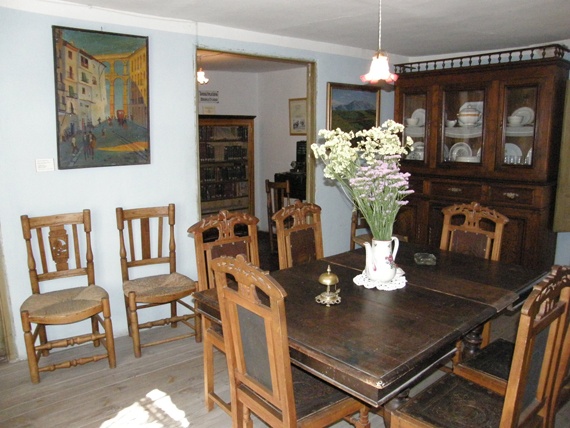
From the moment he arrived, Machado stayed in a humble house, similar to those he had occupied in Soria and Baeza and like so many others of that era. It was a modest guesthouse run by its owner, Luisa Torrego, for which he paid 5 pesetas a day. He remained there until he moved to Madrid.
In Segovia, Machado finds a cultural environment more in line with his tastes and soon connects with the most dynamic and committed sector of the local intelligentsia. He befriends men of letters, joining them to found the Universidad Popular Segoviana, a pioneering educational experience in Spain that arose from the interest of several teachers at the Institute and the Normal School a few days before the poet's arrival in the city. Machado enthusiastically welcomed this initiative and offered free evening courses to the working class, as he had done in Soria. He taught French and literary readings and led lively discussions. The aim of the Popular University was to extend culture to social sectors that had traditionally been excluded from it.
In 1920, Machado began contributing to the newspaper El Sol, the magazine La Pluma, founded by Manuel Azaña, and El Imparcial. These were years of intense activity in the press, as the author of articles with a clear pedagogical focus. This dedication would culminate during the years of the Republic with the publication of Juan de Mairena, and later, during the course of the war.
From Segovia, Machado travelled weekly to Madrid, where he closely followed cultural and political events. These were years of great tension in Spain, with a multitude of events, such as the assassination of Eduardo Dato and the disaster of Annual, which heralded the crisis that would lead to Primo de Rivera's dictatorship.
Machado was no stranger to the complicated situation the country was going through. On the contrary, he became involved with other intellectuals in a multitude of events and initiatives that sought to defend the rights and freedoms that were being violated or sacrificed in the name of order. Thus, on 4 March 1922, he signed the manifesto of the Spanish League for the Defence of Human Rights. Machado became the president of the Segovian delegation of the League and Unamuno the president of the national delegation.
A month later, on 6 April, Machado gave his first public speech in Segovia on the occasion of an art exhibition inaugurated by the Popular University to benefit the starving Russians. He did so in the courtyard of the Casa de los Picos, with the title ‘On Russian Literature’.
During these years, Machado gradually moved away from poetry to devote himself to his numerous contributions to the press, theatre, literary criticism and essays. In 1923, he published his Proverbios y cantares (Proverbs and Songs) in the third issue of Revista de Occidente, founded by Ortega y Gasset and one of the most important cultural publications in Europe. His contributions to this magazine continued from that moment on, along with others in La Pluma, España, Segovia and Alfar, a magazine from La Coruña whose editors paid tribute to Machado on 7 March 1924. Several theatrical adaptations by the Machado brothers of works by Tirso de Molina and Lope de Vega were now premiered. In April of that same year, Nuevas Canciones (New Songs), Antonio Machado's last book of poetry, was published and would be progressively expanded. It collected poems written during his years in Baeza and Segovia up to that date.
In 1925, the second edition of Páginas escogidas (Selected Pages) appeared, and the following year, in February, Antonio and Manuel Machado's first play, Desdichas de la fortuna o Julianillo Valcárcel (Misfortunes of Fortune or Julianillo Valcárcel), premiered in Madrid to great public and critical acclaim. In the following years, Antonio and Manuel Machado, taking advantage of the former's stays in Madrid, wrote and premiered five other plays: Juan de Mañara (1927), Las adelfas (1928), La Lola se va a los Puertos (1929), which became their greatest theatrical success, La prima Fernanda (1931) and La duquesa de Benamejí (1932).
Political and social events continued to concern Machado and the intellectuals of the time. On 11 February 1926, Machado signed the manifesto of the Alianza Republicana, a republican conglomerate formed on the initiative of Manuel Azaña and Alejandro Lerroux, among others, with the common goal of ending Primo de Rivera's dictatorship and the monarchy. The manifesto was endorsed by figures from various backgrounds, such as Blasco Ibáñez, Marañón, Ramón Pérez de Ayala, Ortega y Gasset and Unamuno.
The publication of Abel Martín's Cancionero apócrifo (Apocryphal Songbook) in the Revista de Occidente began. In Machado's own words, ‘Abel Martín and his disciple Juan de Mairena are two poets of the 19th century who did not exist, but should have existed, and would have existed if Spanish poetry had lived through their time’. The work Abel Martín had a long gestation period, around ten years, which began at this time.
On 23 March 1927, after eight years in Segovia, Antonio Machado was elected a member of the Royal Spanish Academy. He would never take up his seat, which corresponded to the letter V. In 1931, he drafted an inaugural speech, which remained in draft form.
On a personal level, Antonio Machado was experiencing a second youth at this time. In June 1928, Machado met Pilar Valderrama, a poet from Madrid who belonged to the upper middle class and was a supporter of the monarchy. It was in the lobby of the old Hotel Comercio. The next day, they had dinner together and took a walk to the Alcázar Gardens. This encounter revived Machado's heart. After experiencing intense love and pain due to the tragic loss of his beloved Leonor, he found solace for his heart in the poet, at the age of 53. This mature love was rather platonic, as the Guiomar of his last poems was a married woman. Even so, the relationship they maintained until the outbreak of war in 1936 revived a feeling that Machado had already forgotten.
In 1928, the second edition of Poesías Completas (Complete Poems) was published. In September 1929, he published ‘Canciones a Guiomar’ (Songs to Guiomar) in the Revista de Occidente.
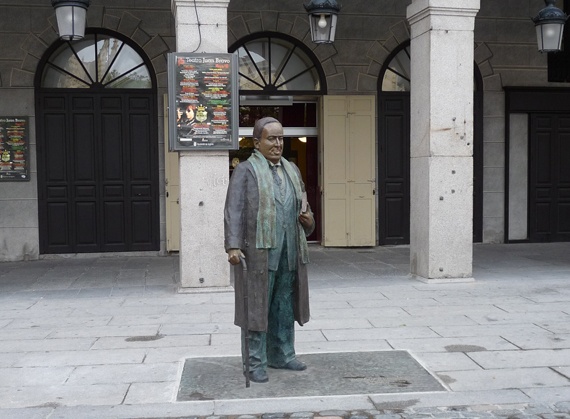
Machado continued to participate actively in the country's turbulent political life. On 14 February 1931, a week after the call for legislative elections, he presided over a Republican campaign rally with the participation of Ortega y Gasset, Gregorio Marañón and Ramón Pérez de Ayala at the Juan Bravo Theatre, in the heart of Segovia's Plaza Mayor. Exactly two months later, on 14 April, the Republic was proclaimed and Machado himself raised the flag on the balcony of the Town Hall.
In September 1932, Machado was appointed professor of French at the Calderón de la Barca Institute in Madrid. The poet left Segovia in October.